
Big Lenders vs Smaller Lenders: Which Is Right for Your Business?
When your business needs funding, the familiar route is often a high-street bank. But bigger is not always better. The right lender is the one whose funding, repayment structure, speed, and service fit your business. Not simply the one with the best-known name.
This guide compares large banks and national finance providers with smaller, specialist and alternative business lenders in the UK, helping you understand your options and decide which might suit your circumstances.
Big Business Lenders: What Do They Offer?
Big lenders typically include high-street banks and large national finance providers. They may offer term loans, overdrafts, asset finance, commercial mortgages, invoice finance, and other facilities.
Their advantages can be significant:
- Potentially lower pricing. Large banks can access lower-cost deposit funding and spread risk across a broad loan book. This can support competitive rates for lower-risk borrowers.
- Established relationships. If you already bank with a lender, it may understand your account history and make introductions easier.
- Broad product range. A major bank may be able to support several needs, from day-to-day banking and equipment finance to property and longer-term borrowing.
- Scale and infrastructure. Larger institutions often have established processes, digital banking and wide branch or support networks.

Conventional Can Be Confined and Uncomfortable.
Bank lending tends to be most straightforward for established, lower-risk businesses. They look for strong accounts, security, and predictable cash flow.
Research notes that most high-street lending currently goes to lower-risk, larger and longer-established firms.
Applications can also require substantial documentation. HSBC, for example, asks business borrowers for information about the business, its owners, investment, purpose, amount, and repayment term. For some businesses, that process is appropriate. For others, it takes longer than they need¹.
Smaller Business Lenders: How Are They Different?
Smaller lenders include specialist finance companies, alternative business lenders, and boutique funders. In the UK, this space includes providers such as Funding Alternative, Bizcap, Got Capital, Swiftfund, and Penny Freedom.

They are not all the same. Some focus on speed, others on invoice finance, revenue-based repayment or carefully assessed working-capital funding.
However, common characteristics include:
- Direct access to decision-makers. You may speak with the people assessing your application rather than moving through several departments.
- More personal communication. Smaller teams can often explain decisions, answer questions, and respond quickly when circumstances change.
- Specialist understanding. A lender focused on SME cash flow may understand seasonal trading, late customer payments, supplier pressure, and short-term growth opportunities better than a generalist lender.
- Flexible funding structures. Some alternative lenders offer repayments linked to revenue, fixed short-term repayments, or funding against selected invoices.
- Practical eligibility assessments. Some assess live trading performance and cash flow rather than relying only on filed accounts and a long credit history.
Smaller Does Not Automatically Mean Cheaper.
A specialist lender may be faster and more flexible, but its pricing can be higher than a bank’s, particularly for higher-risk or short-term funding.
Always compare the total amount repayable, fees, repayment frequency, term, security, and any personal guarantee.
Big Lender vs Smaller Lender: Comparing Your Options
Neither type of lender is automatically better. The differences become clearer when you compare what each can offer.| Big Lender | Smaller / Alternative Lender | |
| Best suited to | Established businesses with strong financials, security or an existing banking relationship. | Businesses needing working capital, flexible repayment, or a more individual assessment. |
| Pricing | Can be competitive for lower-risk, well-supported applications. | Varies by provider and risk; may be higher for speed, flexibility, or higher-risk lending. |
| Application process | Often involves more documentation and assessment time. | Often simpler, although standards differ by lender. |
| Speed | Can take longer, especially for larger or secured facilities. | Often faster; some providers give indicative decisions in hours. |
| Service | May be process-led and departmental. | Often more direct, with named contacts and closer communication. |
| Security | May require business or personal security. | Varies; some require personal guarantees, others do not. |
| Product range | Usually broad. | Often focused on particular funding needs. |
When a Big Lender Might Be the Better Choice
A larger bank or national lender may be the right route if:
- Your business has several years of strong, documented trading history.
- You need a larger facility, such as commercial property, equipment, or long-term growth finance.
- You have assets or security available.
- You already have a productive relationship with your bank.
- You can wait for a fuller assessment in exchange for potentially lower borrowing costs.
For example, a profitable manufacturer buying a £250,000 piece of machinery may benefit from a bank’s asset-finance team, particularly if it has a strong balance sheet and an established banking relationship.


When a Smaller or Alternative Lender Might Be a Better Fit
A smaller or alternative lender may suit you if:
- You need working capital for stock, payroll, supplier invoices, or a short-term opportunity.
- Your business is profitable but has uneven cash flow.
- You need a decision quickly.
- A traditional bank has declined you, offered too little, or cannot move at the pace you need.
- You want to speak directly with someone who understands your business.
For example, a retailer preparing for a busy season may need stock now but will not receive the sales revenue until later. A revenue-linked advance could align repayments with trading.
Alternatively, a business waiting on several large customer invoices may prefer selective invoice finance
What is the Funding Alternative Fit?
Funding Alternative is a UK SME funding specialist offering three products, each designed for different business funding requirements.
Business Cash Advance (BCA):
Unsecured funding repaid through a fixed model or as a percentage of bank receipts, with a minimum weekly amount.
Merchant Cash Advance (MCA):
Funding repaid in proportion to card-terminal takings, so repayments flex with daily sales.
Selective Invoice Financing (SIF):
Funding against selected unpaid invoices, with an advance of 80% of invoice value.
Funding Alternative works with UK businesses that have at least six months’ trading history and six months’ business ownership. Eligibility requirements vary by product:
Business Cash Advance: £25k+ monthly turnover.
Merchant Cash Advance: £15k+ monthly turnover.
Selective Invoice Finance: No minimum turnover. You choose which invoices to fund, rather than financing your whole ledger.
Funding starts at £15,000 and goes up to £250,000. Funding Alt aims to give an initial decision within four hours of receiving all the information. Final approval is subject to underwriting and credit checks.
The approach is deliberately more personal than that of a large bank. Applicants can access a knowledgeable team, receive personal communication throughout the application and work with a lender that takes a close interest in the health of their business.
Funding Alternative describes its model as “equity-like without taking equity”. It underwrites carefully and supports the businesses it funds, rather than simply lending and collecting.
That means taking the time to understand your business and structure funding you can realistically repay. It also means
Funding Alternative is rated “Excellent” at 4.4 out of 5 on Trustpilot, based on verified customer reviews. As with any lender, prospective borrowers should read recent reviews, ask questions, and review the agreement before proceeding.

7 Things to Compare Before Choosing a Business Lender
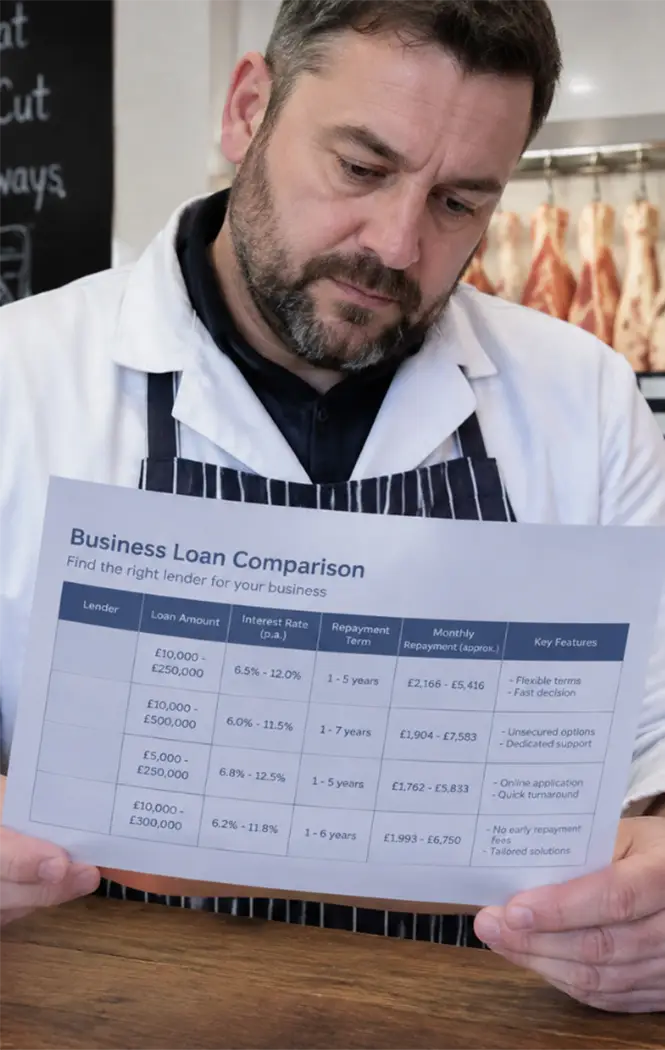
Whichever lender you approach, compare the actual offer rather than the headline funding amount.
Pay particular attention to:
- Total repayment: Not just the advance, but everything you will repay.
- Fees: Fixed fees, arrangement fees, default charges, and early-settlement terms.
- Repayment frequency: Daily, weekly, monthly, or linked to sales.
- Term: How long you will be repaying.
- Security: Debentures, personal guarantees, or other security.
- Flexibility: Whether you can repay early, top up or pause in exceptional circumstances.
- Service: Who you speak to, how quickly they respond and how clearly they explain the offer.
Pricing varies by provider and risk. Secured borrowing can put assets at risk if repayments are not maintained, while a personal guarantee means a director may become personally liable.
The British Business Bank² emphasises that affordability and eligibility are central considerations when applying for business finance.
The Right Business Lender Is the One That Fits
Your funding provider decision should come down to what your business needs, what you can afford and the kind of relationship you want with your lender. A familiar name is not necessarily the best fit, and faster might not be more affordable.
If you are considering funding, speak to Funding Alternative to explore whether a Business Cash Advance, Merchant Cash Advance or Selective Invoice Financing could be the right fit.
A conversation with the team can help you explore your options and establish whether the funding is right for your business before you commit to anything.